If you’re thinking about selling your software business, you’ll probably hear two broad options. One is a sale to a private equity (PE) firm. The other is a sale to a buy-and-hold acquirer that intends to own the business permanently. Both can offer a good outcome, but they work on different timelines, and in 2026, the market has made those differences easier to see.
Two models, two different clocks
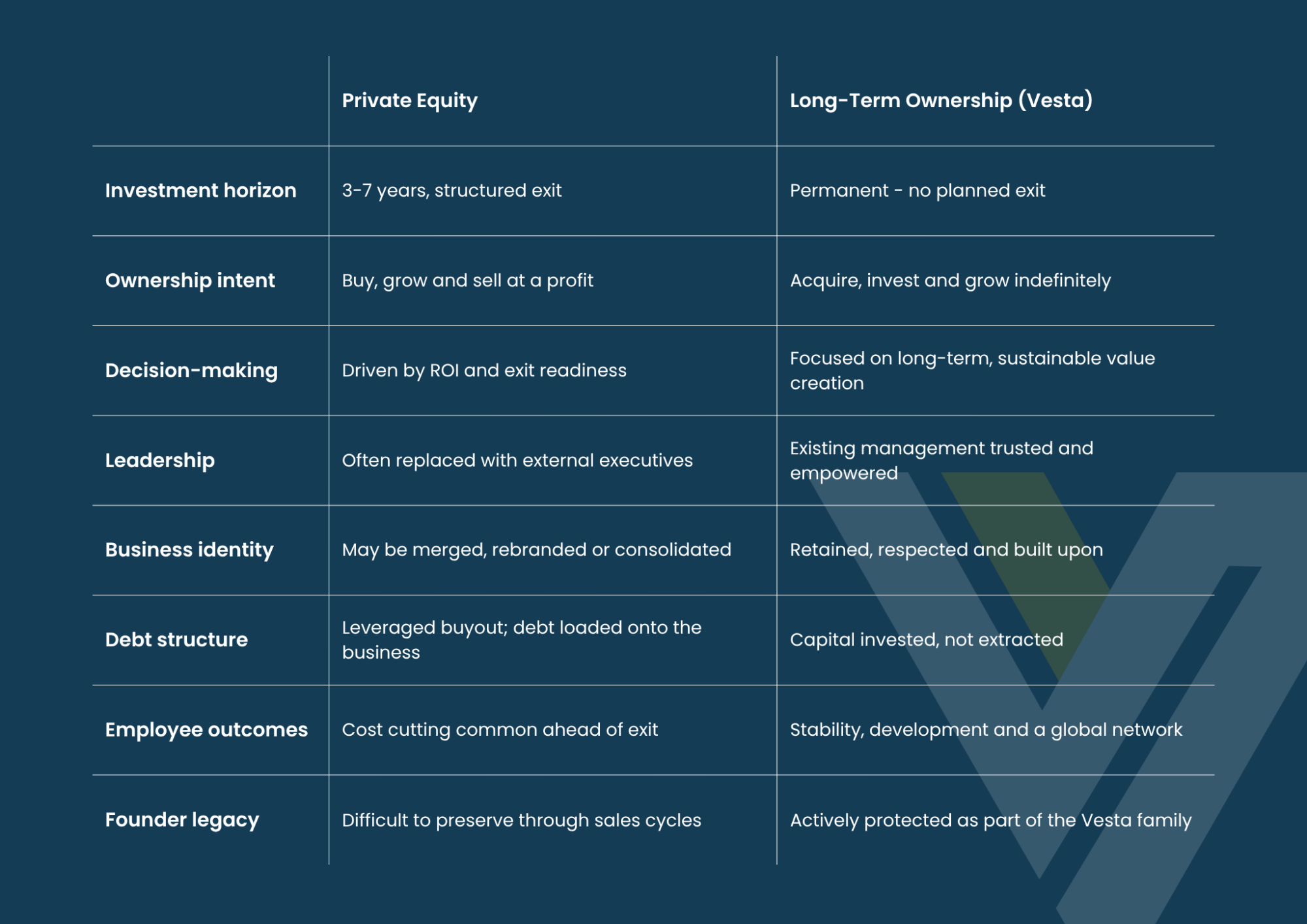
A private equity fund has a fixed life. The firm buys a business, aims to grow its value and plans to sell it within a defined period, typically somewhere between three and seven years. Everything about the ownership, from investment decisions to hiring to pricing strategy, is shaped by that exit.
A buy-and-hold acquirer has no such deadline. At Vesta, we’ve made more than 70 acquisitions across 20+ countries and have never sold a single business. That permanence changes the questions we ask. Rather than asking what a business will be worth to the next buyer, we ask what it needs to be a strong, healthy company over the next ten or twenty years.
What the industry looks like right now
The wider private equity market gives useful context. Bain’s 2026 Global Private Equity Report puts the number of unsold companies in PE portfolios at around 32,000, worth roughly $3.8 trillion, with average holding periods at exit of around seven years. Plenty of sponsors are holding assets for longer than they planned.
Software has felt this more than most. PE firms completed a record $290 billion of software buyouts in 2025. In the first five months of 2026, deal value fell to about $50 billion, from $88 billion in the same period a year earlier. Bain also found that software company valuations dropped around 8% in the first quarter of 2026, against a 0.3% decline across all other sectors.
Much of the caution comes from uncertainty about how AI will change software businesses. An EY survey found that 64% of PE firms had become more selective about software investment because of AI disruption risk, and more than a quarter of active PE-owned software companies in North America were acquired at least five years ago. Bain’s data also shows that buyouts completed between 2020 and 2022 returned a median of 2.1x at exit, compared with 2.9x for tech buyouts from 2010 to 2019.
None of this means PE is a poor choice. It does mean, however, that a business acquired at peak prices, with a fund needing to show returns, can be under real pressure to improve earnings within a set window. That can shape decisions about headcount, product investment and leadership. If the exit takes longer than planned, the business may stay under that pressure for longer or move to another owner with a different plan.
Where private equity does well
Fairness matters here. PE firms bring capital, speed and structured operating playbooks, and some are very good at helping a business scale quickly. For a founder who wants to stay involved, reinvest in the business and take a second bite at the apple on a later exit, a PE partnership can make real sense.
The question is whether that approach matches what you want for your business, your team and your customers once the sale completes.
Why buy and hold suits vertical market software
Vertical market software tends to be mission-critical for the customers who use it. It’s built around the specific workflows and regulations of an industry and it often takes years to develop that depth. Silverpeak’s H1 2026 Software M&A Report notes that investors are increasingly separating software that AI erodes from software that AI accelerates, and that conviction stays high for businesses that are mission-critical, data-rich and deeply embedded. That description fits a great many vertical market software companies.
Businesses like these reward patience. Customer relationships compound, product knowledge deepens and the teams who understand the market become more valuable over time. A long-term owner can invest through the cycles, including the periods when the market is uncertain, because there is no exit date forcing a different decision.
This is how Vesta operates. Our businesses keep their brand, their leadership teams and their way of working. As part of the wider Constellation Software Inc. family, they also gain access to the data, KPIs, lessons learned and best practices of thousands of vertical market software companies. In Latin America, where our first acquisitions were made five years ago, Qwantec’s revenue has grown by approximately 130% since joining us in 2022, which shows what local expertise can achieve with long-term backing.
Questions worth asking any acquirer
Whichever route you’re considering, these questions will tell you a lot:
- How long do you intend to own the business, and have you ever sold one you acquired?
- How is the acquisition structured? Will debt be placed on the business?
- Will the existing leadership team stay in place?
- What will change after completion, and what will stay the same?
- Can I speak to founders who have already sold to you?
We cover the differences in more detail in our guide to private equity vs long-term ownership.
So, which is better?
The honest answer depends on what you want. A founder who wants to scale aggressively and plans another exit may find a PE partner a good fit. A founder who wants their team looked after, their brand and customers protected, and the business to carry on growing under stable ownership will usually find buy and hold a better match.
At Vesta, we believe great vertical market software businesses deserve a permanent home. If you’d like to talk about what that could look like for yours, we’d welcome a conversation.