
When founders of vertical market software businesses start thinking about a sale, the decision is rarely straightforward. It’s not just about finding a buyer, it’s about finding the right one. Someone who understands what you’ve built, will look after the people in it and won’t simply flip it on to the next highest bidder in a few years.
In this article, we explore the fundamental differences between private equity and long-term, buy-and-hold ownership – what they each mean in practice for your business, your team and your legacy – and the questions every founder should be asking before making one of the most important decisions of their career.
What is the difference between private equity and long-term ownership?
At its simplest, the difference comes down to intent. Private equity firms raise capital from institutional investors with a clear mandate: deploy it, generate a return and exit – typically within three to seven years. Long-term acquirers, by contrast, buy businesses with no intention of selling them.
At Vesta, we’ve built our entire model around this distinction. We’re a global buy-and-hold acquirer of vertical market software companies, and every decision we make – from how we structure an acquisition to how we support a business post-close – flows from that permanent commitment. We’ve never sold a single business we’ve acquired, and we have no plans to start.
That might sound like a simple point of difference. But in practice, it changes everything about how a business is owned and operated after the transaction closes.
What does private equity ownership actually look like?
Private equity investment has helped many software businesses grow quickly and reach scale, but the model carries structural features that founders should understand before choosing this path.
When a PE firm acquires a vertical market software business, the typical picture looks like this:
- A defined investment horizon of 3–7 years, after which the business will be sold
- Decisions shaped by what will make the business attractive to the next buyer, not what’s best for it long-term
- A leveraged buyout structure, meaning significant debt is loaded onto the acquired business
- Leadership changes, as PE firms often bring in executives aligned to their exit thesis
- Cost rationalisation in the run-up to exit, which frequently affects headcount and investment
- The real possibility of being sold again (and again) as ownership cycles through
None of this is hidden. It’s simply how the model is designed to work. The challenge for founders is that many of the things they care most about – the team, the culture, the product, the customers – can become casualties of a process that was never really designed with those things at its centre.
In practice, PE investors often shape a business with a specific buyer profile in mind – whether that’s a strategic acquirer, a larger PE fund or a public market. Decisions about product investment, headcount and market positioning are made not on the basis of what’s right for the business, but on the basis of what that future buyer is likely to want. Cost reductions and a reassessment of investment priorities can improve short- to medium-term returns, but they can equally compromise the long-term sustainability of the business. And in many cases, any resulting structural challenges are simply passed on to whoever comes next.
What does long-term ownership look like in practice?
When Vesta acquires a business, the conversation with the founder doesn’t end at close; it’s just beginning. Our model is built on the belief that the people who built a business are best placed to run it. We don’t parachute in a new leadership team or impose a centralised operating model. We don’t have a fund lifecycle counting down in the background. And we don’t have a future buyer we’re quietly dressing the business up for.
What we do instead is provide the things that allow a business to grow on its own terms:
- Patient capital invested into the business, not extracted from it through debt
- Operational independence, with the existing management team trusted and empowered
- Access to a global network of operators across more than 20 countries
- Shared best practices, rigorous KPI analysis and data drawn from over 2,000 vertical market software companies – made possible through Vesta’s place within the Constellation Software family
- Support for both organic growth and further acquisitions, without the pressure of a deadline
The businesses in the Vesta family keep their identity, their brand and the things that made them worth acquiring in the first place. We’re not buying businesses to change them. We’re buying them because we believe in what they’ve built and want to help them go further.
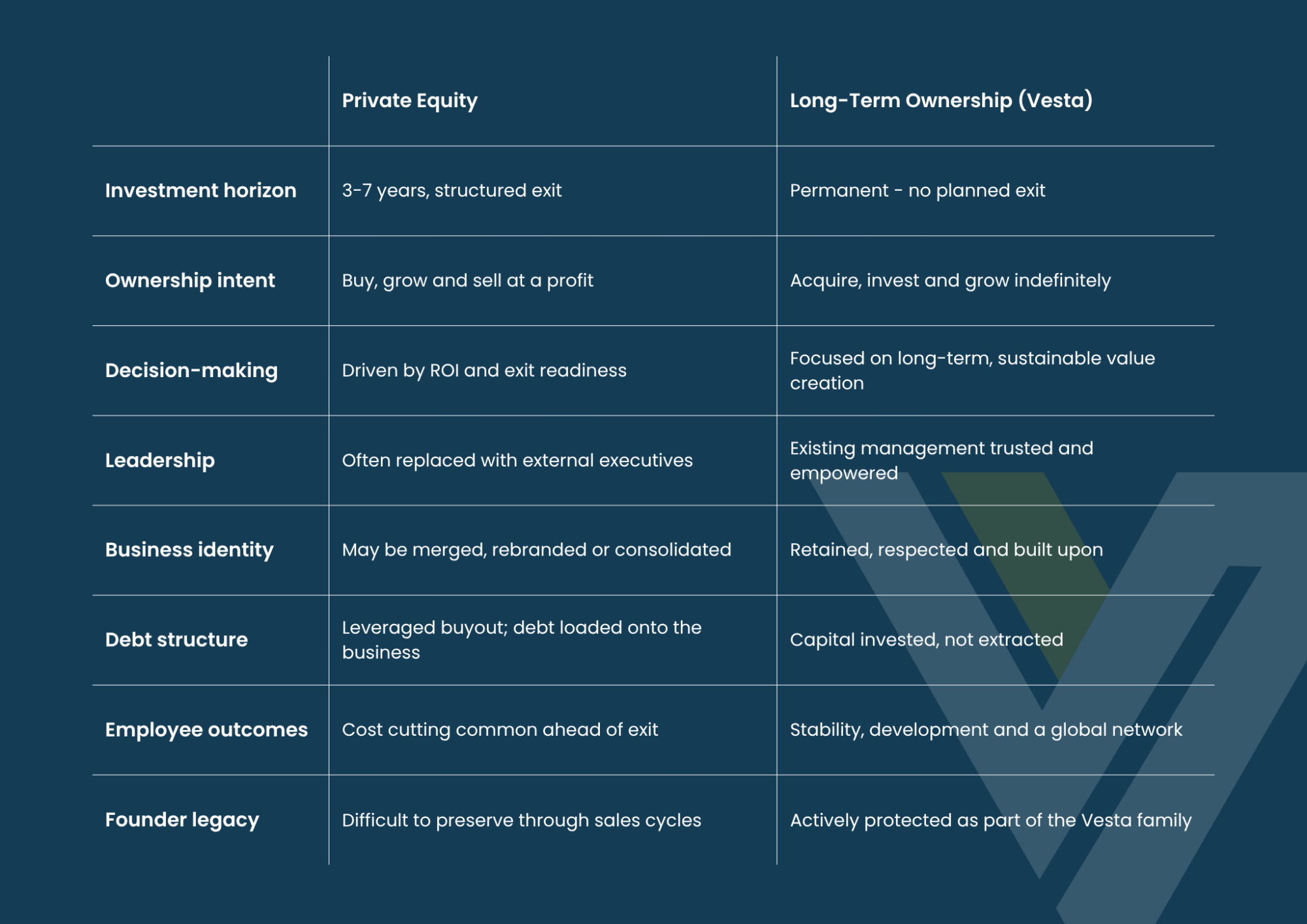
How do private equity and long-term ownership compare?
For founders evaluating their options, here’s how the two models stack up across the areas that tend to matter most:
Why does the type of acquirer matter in vertical market software?
Vertical market software businesses are not generic assets. They’re mission-critical systems built on deep domain expertise, long-standing customer relationships and years of specialised knowledge that can’t be easily replicated or replaced. That’s what makes them so valuable.
At Vesta, we’ve spent years focused exclusively on this space. When you’re holding a business permanently, you invest in it differently. You hire for the long term, build for the next decade and treat the customer relationship as the asset it actually is. That alignment – between the interests of the acquirer and the long-term health of the business – is something we think every founder in the vertical software space deserves to find in a buyer.
That raises a natural question: if Vesta isn’t extracting value through an eventual sale, where does growth come from? The answer lies in a fundamentally different approach. Through the consistent application of best practices, rigorous KPI analysis and the leverage of a global network, we help the businesses in our portfolio improve continuously – without the pressure of an artificial deadline. As part of Constellation Software, Vesta also benefits from access to the data, lessons learned and accumulated expertise of over 2,000 vertical market software companies worldwide. That depth of knowledge – combined with the opportunities that come from geographic expansion and product development – means we can provide our portfolio companies with genuine competitive advantages, grounded in long-term stability rather than short-term optimisation.
What should founders consider beyond the valuation?
In our experience, the founders who choose Vesta aren’t primarily motivated by getting the highest possible number. They’ve usually had that conversation, and they’ve decided it’s not the only one that matters. What they’re looking for is confidence – confidence that the business they’ve spent a career building will be in good hands, that the team they’ve assembled will be looked after and that the work won’t simply be absorbed into something unrecognisable within a few years.
These are the questions we think every founder should be asking any prospective acquirer:
- Will the existing management team be retained or replaced?
- Will the business maintain its brand and independence, or be merged into a platform?
- How will the acquisition be structured, and will debt be loaded onto the business?
- What is the acquirer’s track record with businesses of a similar size and type?
- What happens to employees after the acquisition?
- Will the acquirer be a permanent owner, or will the business be sold again?
At Vesta, we welcome every one of those questions. Our answers are consistent because our model is consistent, and we’re always happy to connect prospective founders with those who have been through the process with us.
Frequently asked questions
What is the typical investment horizon for a private equity firm?
Most private equity funds have a target investment horizon of three to seven years, after which the business is sold to generate a return for the fund’s investors.
Does Vesta Software Group ever sell the businesses it acquires?
No. Vesta is a buy-and-hold acquirer, and we’ve never sold a business we’ve acquired. That permanent commitment is central to how we operate and how we build trust with the founders who choose to work with us.
What is a leveraged buyout (LBO) and how does it affect an acquired business?
A leveraged buyout is a common PE acquisition structure in which a significant portion of the purchase price is funded through debt, which is then placed on the balance sheet of the acquired business. This can constrain the business’s ability to invest and create pressure to service debt obligations rather than grow.
Will my business keep its identity and independence after being acquired by Vesta?
Yes. Businesses in the Vesta portfolio retain their brand, their leadership team and their operational independence. Our decentralised model is built on the belief that the people who built a business are best placed to run it, and we have no interest in overriding that.
What happens to employees when a software business is acquired by private equity?
PE acquisitions frequently involve cost rationalisation, particularly as the business is prepared for exit. This can mean headcount reductions, restructuring or changes to employee benefits. Long-term acquirers, with no exit pressure, have fewer structural incentives to reduce costs in this way.
The bottom line
Choosing the right acquirer is one of the most consequential decisions a founder will ever make. The difference between a private equity firm and a long-term, buy-and-hold acquirer isn’t just a matter of structure or timeline; it’s a difference in values, incentives and what the acquisition is ultimately for.
At Vesta, our approach is built around a simple belief: that great vertical market software businesses deserve a permanent home – one that will invest in them, respect what they’ve built and give them the best possible platform to keep growing.
If you’re at that crossroads, we would be glad to have the conversation.